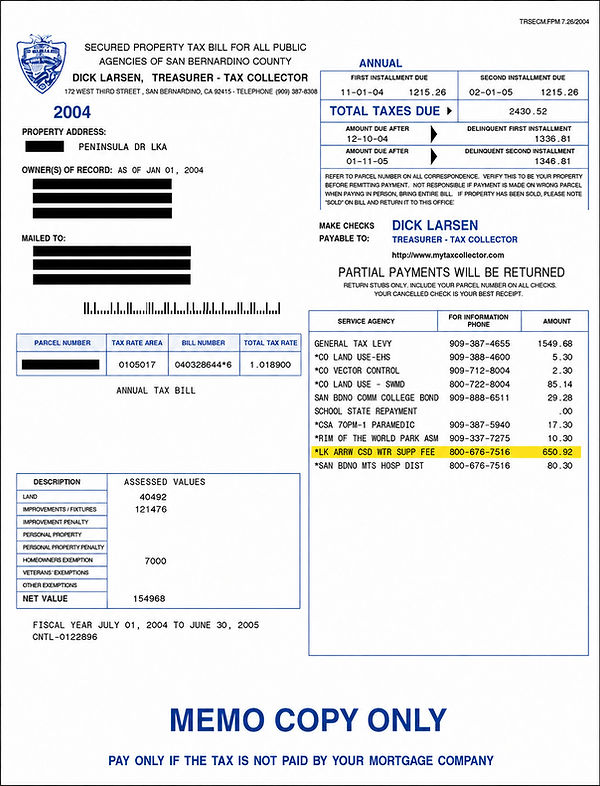
2004: Ordinance No. 61 and the Supplemental Water Fee.
Ordinance 61: How a “Supplemental Water Supply Fee” Became Part of the Recycled Water Story.
Most Lake Arrowhead ratepayers have probably never heard of Ordinance No. 61.
But they paid for it.
In 2004, the Lake Arrowhead Community Services District adopted Ordinance No. 61, creating what was called the Supplemental Water Supply Fee. The fee was not presented as an ordinary water bill charge. It was presented as a special, temporary funding mechanism to help LACSD secure additional water supplies for the community. Not a single vote was cast in support of this added property tax levy.
The public justification was straightforward: Lake Arrowhead could not remain the District’s only practical water source. LACSD needed to diversify its water supply, reduce reliance on the lake, purchase imported water when necessary, and build long-term alternative water infrastructure.
On paper, that sounds reasonable.
The fee was imposed for approximately 15 years. It was collected from ratepayers through the County property tax roll. The money was supposed to help fund supplemental water supplies and related capital facilities, including imported water, groundwater wells, and recycled water infrastructure.
That is the first part of the story.
The second part is where the public should start asking questions.
A substantial portion of the early Supplemental Water Supply Fee money appears to have gone into the recycled water project. That project ultimately supported the delivery of recycled water for irrigation at Lake Arrowhead Country Club. So the question is not simply whether LACSD needed more water in 2004. It probably did.
The real question is this:
Did ratepayers fund a community-wide water security program, or did they end up funding infrastructure whose most direct and visible beneficiary was the Country Club?
That distinction matters.
If a fee is imposed on the public for systemwide water security, then the public should receive a systemwide benefit. If the fee-funded infrastructure primarily supports recycled irrigation water for one private user, then the public deserves a clear explanation of why all ratepayers were asked to pay for it.
This is especially important today because the recycled water issue has not gone away. LACSD has identified major future costs associated with keeping the recycled water system operating. Those future costs may again fall on the ratepayers, even though the direct operational benefit appears to remain concentrated in the Country Club irrigation arrangement.
That is why Ordinance 61 is important.
It helps explain how the recycled water system was originally financed. It also helps explain why ratepayers should be asking harder questions now.
This is not about blaming every past decision. In the early 2000s, LACSD faced real pressure to develop alternative water supplies. The community had legitimate concerns about lake withdrawals, imported water, drought risk, and long-term supply reliability.
But a reasonable purpose at the beginning does not answer every question about what happened later.
Ratepayers are entitled to know:
-
Was the Supplemental Water Supply Fee used in a way that produced a proportionate public benefit?
-
How much of the fee money went into recycled water infrastructure?
-
Who actually received the practical benefit of that infrastructure?
-
And why should today’s ratepayers be expected to fund additional future upgrades if the principal beneficiary remains the Country Club?
Those are fair questions. They are not hostile questions. They are the questions any responsible ratepayer should ask when public money is used to build and maintain infrastructure that appears to serve a narrow private use.
The broader issue is accountability.
For years, LACSD ratepayers have been asked to trust that these arrangements were in the public interest. But trust is not a substitute for transparency. If the recycled water arrangement truly benefits the entire community, LACSD should be able to explain that benefit clearly, in dollars, acre-feet, avoided costs, and actual ratepayer savings.
If it cannot, then the public should reconsider whether this arrangement still makes sense.
Ordinance 61 was born out of a promise: ratepayers would pay extra to help secure Lake Arrowhead’s long-term water future.
Now the community deserves to know whether that promise was fulfilled — or whether the fee helped create a long-term subsidy that ratepayers are still being asked to support.